Wednesday, March 1, 2017

Investigating Animal Track & Sign at Tennant Lake Interpretative Center

The Black-tailed Deer arrived at the Tennant Lake Interpretative Center clearly excited to explore a new location. Once everyone had gathered we headed out in search of a spot for our opening circle. Settling in the mentors nominated a Tribal Elder and let the group know that we had three Environmental Education Students from WWU who would be exploring with us; Anna, Ciera, and Nina. The Explorers were informed that our volunteers were not only interested in exploring this unique location with us, but that they also wanted to learn about our Explorer Club culture. What better way to teach our culture than with a strong opening circle facilitated by the boys?

After handing out jobs and going over location safety concerns, the mentors presented the group with our core routines for the day: engaging in our seasonal skill of bird language and behavior, playing a game called Jays and Juncos, having a sit spot, and exploring the mile-long wetland boardwalk. The Tribal Elder did an excellent job of facilitating the group decision-making process and helping the group come to a collaborative decision to explore the wetland first and take a sit spot on the boardwalk.

As we walked the mentors chatted with the boys about the importance of wetlands for providing habitat, water purification, trapping sediment, preventing flooding, and allowing water to slowly seep into the ground table. Crossing over the first bridge the boys spotted a few Coots feeding on the aquatic plants. We also took a moment to discuss a plant that has been coined nature’s grocery store, Cat Tail. Almost every part of this plant is edible and it provides excellent nesting habitat for Marsh Wrens and Red-Winged Blackbirds. Harvesting a few of the Cat Tail’s the boys crushed up the cone shaped flower on the top of the stem and waved them around like wands, releasing the seeds into the wind.

Arriving at the boardwalk the boys investigated the roof of a beaver lodge that was thought to be abandoned for many of years. The lodge must have been fifteen feet in diameter. Looking closely the boys noticed fresh beaver chews and sticks that had been added to the holes in the roof. How cool to think that a lodge could be reclaimed and reused! One of the amazing parts about this location is the multitude of animal tracks and signs. Walking the boardwalk the group found beaver highways and chews through the Sweet Gale and Pacific Willow, River Otter scat, and all types of interesting fungi. They also had a great time smelling the “Pine Sol” scented beaver scent mounds and releasing the methane bubbles trapped in the sediment layers of the wetland.
Finding an open space on the boardwalk the group lunched and viewed some Mergansers hiding among the Cat Tail’s as a Sharp-Shinned Hawk patrolled the skies overhead. After lunch we came across an expansive view of the wetland and decided that it would be the perfect place for our sit spot. Tucking away in the Sweet Gale the boys got quiet and listened for birdcalls. As one of the mentors sat a Marsh Wren darted between him and another Explorer. Although the birds are not particularly vocal at this time of year, late winter is often the time when a number of species establish their breeding territories. 

Our solo time was quiet and going well until a number of other park users started to walk by. This caused a chain reaction in the boys and they started to get squirrely. One mentor stood up to make sure that they were leaving enough room for the other park users and stepped right off the boardwalk, soaking his pants and flooding his boots! The boys thought this was quite hilarious, as did the other mentors.
On the way over to the other side of the park the group continued to harvest Cat Tail’s and were becoming a little rowdy and they waved them around to disperse the seeds. This was an important time to circle up and talk about being respectful of the work the park staff puts into keeping the park clean and being aware of how and why we are harvesting resources and what other species might need them too.
Walking through the grass field on the way over to the patch of forest along the Nooksack River the boys played games of Hide! and viewed a pair of Bald Eagles repairing their nest in a large Cottonwood. Arriving at the location where we intended to play games we saw the river was blown out and the forest held about a foot of standing water. Turning problems in possibilities Jedidiah led the boys in a tracking exercise following some coyote scat and digs in the myriad of vole holes along the edge of the field. This led us straight to the giant Cottonwood and we got an up close and personal view of the Eagle’s nest.
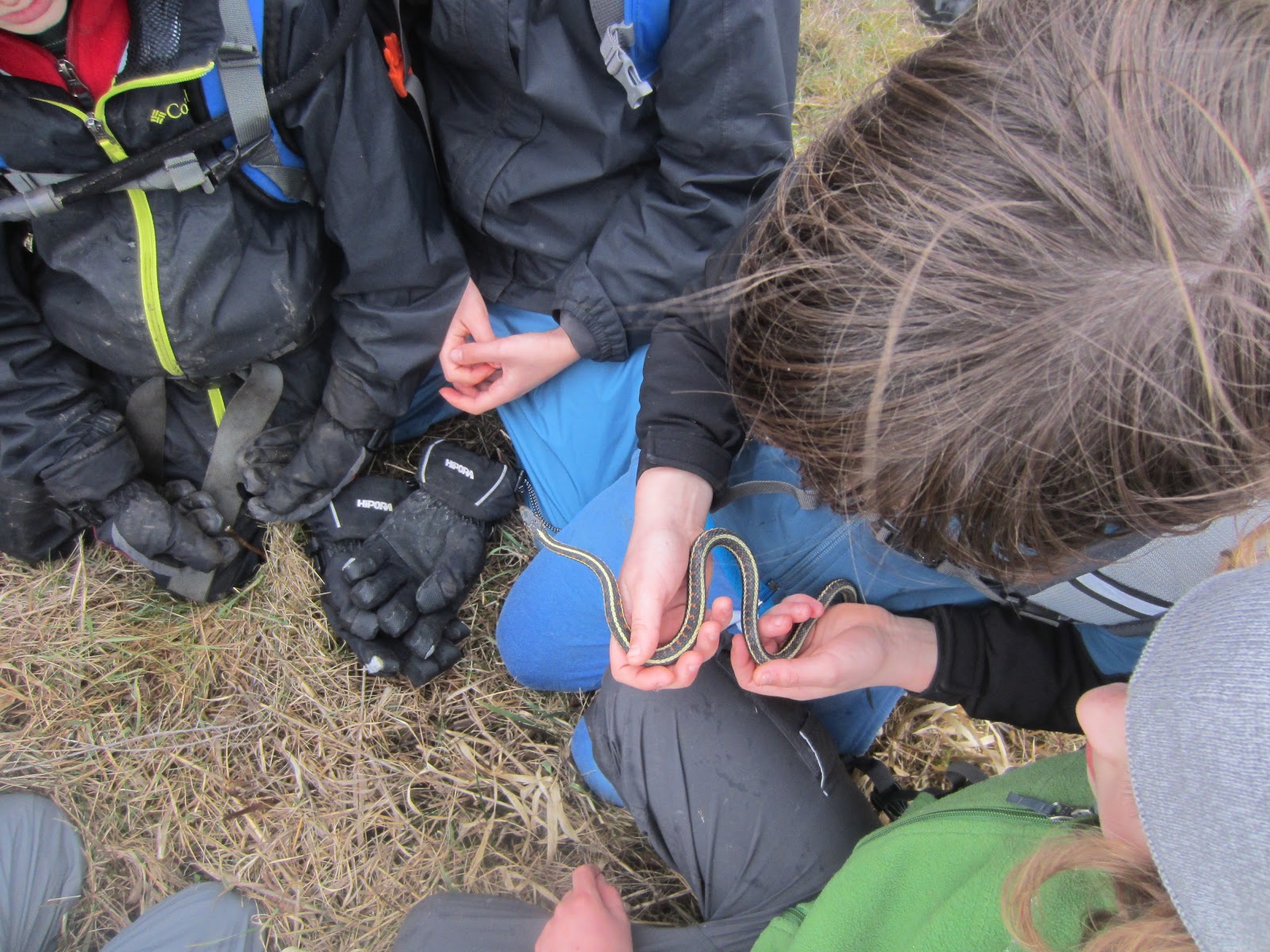
Arriving at the Hovander farm we found a perfect location to play Jays and Juncos. The game of Jays and Juncos is a great model for helping the boys understand what it’s like to try to find food as a ground nesting bird while trying to keep your young alive from the ever-persistent Jays. After playing a few rounds and experimenting with ratios of Jays to Juncos the boys had some great takeaways around the balance of the forest bird ecosystem and what it was like to have to always stay hyper vigilant and aware of predators.
Circling up one last time we shared our thanks for a powerful day full a genuine Exploration and powerful moments of natural history and animal tracks and signs. The mentors would like to thank our volunteers from WWU for joining us for the day and for Heather Nelson for bringing the group some delicious cupcakes in celebration of her son’s birthday.

For more photos please visit the Black-Tailed Deer photo album from the day.

Monday, January 23, 2017

The Black-Tailed Deer Explore Frozen Streams

The Black-Tailed Deer met last Sunday for their first winter exploration together as a group.  Our outing came at the tail end of a two week cold spell and this was our first chance to see what the woods look, smell, sound and feel like during the icy grip of a winter freeze.  In addition to exploring in the winter for the first time, this was also the first BEC exploration in this spot ever! We were tasked by BEC to scout this spot and decide whether or not it would be a good place to come back to with other groups. 
Frozen streams!

We started our day by traveling through a section of very disturbed forest.  We noticed lots of blackberry and english ivy, both plants that we recognized as invasive because we had spent time getting rid of them at our service site on Connelly Creek.  In search of a healthier patch of wood, we pressed on into unknown territory.  

We eventually came to a gravel path, and on the other side we began to recognize a healthier forest.  Tall cedars and hemlocks reached skyward and jockeyed for any available sunlight in the canopy.  Instead of blackberries and ivy on the forest floor, here there were sword ferns and huckleberry bushes. We could hear the sound of running water in the distance and we let our ears lead us toward the gurgling brook.

Upon reaching the small stream, we noticed a great variety in the thickness of the ice in different places.  The mentors told us that this is because water freezes more readily when it is moving slow or not at all, and in areas of swift water, the ice would be very thin.  Normally, getting our feet a little wet in a creek was not a big deal in BEC, but the mentors explained to us the new danger of getting wet in such cold weather and how it could lead to hypothermia.  After acknowledging these risks, our inner curiosity took over and compelled us to move onto the ice and begin to explore this frictionless world.

We managed to play on the ice for over an hour before one of us found himself ankle deep in cold running water.  Luckily, this explorer had packed extra wool socks, a must on a cold winter exploration.  As this explorer was changing into dry socks, another one of us found our way into the water! Sometimes we just have to make our own mistakes in order to really come to understand something.  Fortunately, this water was just deep enough to effectively chill our feet and teach us a lesson.

At this point, the mentors thought it wise to move on from the ice.  We let our inner vision guide us to a good spot for spiders web.  We found a suitable spot and sat down for a snack before we playing our first game.  
Snack time/pig pile

We were only a group of seven today, including the mentors.  While we were playing spiders web, we realized that this gave a huge advantage to the spider as he had less flies to keep track of.  In a rare turn of events, the spider actually won two games in a row by successfully returning all of the flies to the web! 
Can you spot the explorer in this picture?

Seeing that our spring season focus is Tracking and Bird Language, the mentors thought it would be a good idea to have a sit spot to end the day and see if we could begin notice some of the bird language in the forest.  This sit spot also allowed us to come to know this forest a bit better as this was a new patch of woods after all.  


After our sit spot, we had our usual closing circle where we shared gratitude and apples.  Back at the cars where our parents were waiting for us, we agreed that these new woods were a great spot to explore and that they likely hold many more unknown and interesting spots that future BEC groups could come and discover. 

Monday, November 28, 2016

Teddy Bear Traverse with The Black Tailed Deer

Our Teddy Bear Traverse was a rich experience full of natural history and exploration. Meeting at the North Chuckanut Trailhead the mentors wanted to cover an important safety topic before we headed out on our traverse. In order to complete our trek and make it to our pick-up location the group would have to cross Chuckanut Drive three separate times. The mentors cautioned the group to stay hyper vigilant and focused during these times.
Lined up and ready for our first crossing both North and Southbound traffic stopped and an annoyed driver tried to pass one of the stopped vehicles. The driver spotted our group across the road and immediately came to a stop. Safely on the other side of the road the boys circled up for our opening meeting and we debriefed what had just happened. It was a great reminder of the number one rule of the wilderness: pay attention.
Looking at a map of the traverse the boys worked hard to orient to the landscape and cardinal directions. Once jobs were divvied up the Tribal Elder facilitated the group’s decision to head due south across the wetland, and we were off!
Crawling and climbing through a dense thicket of Salmonberry, Vine Maple, and Devil’s Club the boys followed each other closely, choosing the easiest lines of travel. Once the group had navigated the wetland the Front Scout made a keen observation. Looking at the retaining wall above us, he suggested that an easier path of travel might be along the wall as there was graffiti it’s entire length; which meant there must have been a footpath at its base. Jedidiah explained to the boys that reading the landscape as the Scout had just done and the type of inference he was able to make from his observations was a key component of tracking and navigation.
The group decided not to venture up towards the retaining wall because of the significant erosion it would cause. The mentors went on to explain that the first quarter mile of our traverse was in the Chuckanut Creek watershed and there were salmon currently spawning. Any erosion we created would significantly impact the salmon runs.
After another twenty minutes of travel through a lush valley of Sword Ferns we arrived at Woodstock Farms and headed down to Mud Bay for some lunch. Looking out across the bay the boys noticed a few clusters of shore birds foraging in the tidelands. Jedidiah pulled out his binoculars and each of the boys took a turn. It was a great day by any birders standards. We spotted Surf Scoters, Goldeneye, Mergansers, Eagles, Heron, and Grebes. One of the boys also noticed that the eroding shoreline seemed to be made up of entirely of clams and oyster shells. Crawling under the overhanging bank the mentors explained to the group that this was a pile of Shell Midden leftover from the Salish peoples. Shell Midden piles can be found throughout the Salish Sea along with all types of artifacts preserved by the calcium from the shellfish. The boys were excited and wanted to dig through the pile but the mentors stopped the group, explaining that it was our job to leave this piece of natural history intact to it would be there for generations to come.
We left Mud Bay and weren’t more than five minutes up the trail when one of the boys called everyone over to puzzle at a bone that he had found. After some investigation the boys discovered that it was a salmon bone. The mentors asked the group why a salmon bone would be so far from the bay. Scanning the landscape the boys determined that it must have been a Bald Eagle feasting on the Salmon from atop a tree. The mentors pointed out that the salmon bones and carcass provide vital nutrients from the ocean to the forest, which wouldn’t be present without their journey up stream.
Nearing our second Chuckanut Road crossing we started to hear voices of what could only be the Girls Explorers Club. Sure enough we crested the hillside and there were three groups of GEC girls working on a service project. We chatted for a little while and the girls let us know that there was an owl pellet ahead on the trail. Saying our goodbyes we rounded the corner and took a close look at the owl pellet, which Jedidiah determined to be Coyote scat with Cottontail bones and fur in it. One of the Explorers pointed out that our traverse through the land was giving us a snapshot of the animals that lived and migrated through this area.
Safely across Chuckanut Drive we made some ground along the interurban trail only stopping to look at a Robin’s nest. Coming to our last Chuckanut Road crossing the group was very patient as they waited for the seemingly endless line of cars to pass by. Hiking down the steep switchbacks the boys realized they had made it to Teddy Bear Cove.
Pulling out the remnants of their lunches the boys spread out over the Sandstone bluff and soaked up the views. NOAA had forecasted heavy rain for our outing, but miraculously the day had been dry with the occasional sun break. Looking over the Olympic Mountains the sky was fiery orange and yellow and we could see the almost sheet like rain coming down in buckets. It was a great time for the boys to decompress and revel in their accomplishment.
The boys wanted to spend some time on the beach and navigated to the North side of the cove where they spent quite awhile harvesting clay from the embankment near the breakwater. This was the perfect container for the mentors to sit back as the boys engaged in free play. Their play led to two more natural history discoveries: River Otter poop and the mysterious intertidal creature called a Hooded Nudibranch.
Calling the group together we played a few rounds of Otter Steals a Fish and circled up for our closing meeting. The boys gave thanks for the fall season and for all the mystery and wonder that lives in the landscape. This closing meeting would mark the end of the first half of our 2016/17 season of traverses. Looking back we recalled each our traverses and revisited the powers and challenges of our experiences. Our mentors look forward to picking up where we left off in mid-January. Parents, dates for the second half of the 2016/17 season will be posted on the Black-tailed Deer group page by December 5th.  We appreciate all your support and encouragement for the work we do. We hope you have a wonder Holiday break!

For more photos from our outing please visit the BTD’s photo album from the day.

Monday, October 17, 2016

Sehome Arboretum Traverse with the Black-Tailed Deer

The Black-Tailed Deer arrived at the Sehome Arboretum to a closed gate just before the lower parking lot. Upon further investigation the group found that someone had actually crashed into the gate, bending the steal pole that connected its two sides. It would need to be cut open. Fortunately for the police officers that later arrived on the scene, the driver who crashed into the gate and fled left their license plate behind!
After introducing Jedidiah Forsyth, our newest BEC staff and the Black-Tailed Deer new consistent mentor, we circled up for an opening meeting. Looking around the circle we had a few new faces to the group and there was a need to introduce ourselves, review the outing jobs, group culture, and safety. Once our focus was brought back towards our exploration, the group talked about an EC motto, turning problems into possibilities. The boys decided that even though the parents could not pick us up at the top of the Arboretum they wanted to try to complete a round trip hike and make it to the lookout tower.
Before heading up the trail Jedidiah showed the boys a skull he had recently found in the 100-Acre Wood. Jedidiah asked the group what type of animal did they think this skull belonged to? Through questioning and observation the group deciphered that it was an adult raccoon skull. Jedidiah then went on to ask them how the raccoon died. The boys puzzled over this mystery until they reached their breaking point and asked Jedidiah to reveal the mystery. Pointing out the teeth marks on top of the skull and thinking about the large mammals live in the 100-acre wood, he said it was most likely a Coyote. Through this investigation the boys learned that sometimes the answers to questions can be found when we slow down and use our observation skills and the critical thought process.
Heading out on the trail we used the group decision-making, facilitated by our Tribal Elder, to determine which trail we wanted to follow to the top. The day was beautiful and the colors of fall were abundant in the canopy of Big Leaf Maples and Red Alder. After climbing up the ridge and playing a few rounds of hide we came to a Sandstone Cliff.
The boys asked if we could follow the steep path to the bottom to do some bouldering and free exploration. The mentors felt that the boys could handle the risk management aspect of the location, but reminded the group that we are all mutually responsible for each other’s safety, and it was on that contingency that we could explore the location.
The boys bouldered on the cliff until it was time for lunch. As we ate a few of the Explorers started to lose their awareness while near the cliffs edge and the mentors decided it was time to move.
Along our journey to the lookout we discovered Banana Slugs, Vanilla Leaf, Snowberries, and Oceanspray. Arriving at the tower the boys gathered Samara seedpods from Big leaf Maples by the handful and launched them from the top of the tower. Watching the Samaras “helicopter” downwards the boys were enamored and the activity quickly turned into a game of seeing how many they could catch. The moment was spontaneous and engaging. In-between Samara launches the boys soaked up the clear views and sunshine while the mentors oriented them to the topography from Bellingham’s watershed to the Nooksack Delta. We also caught some glimpses of the Cascade Mountain peaks!
Feeling some inspiration and the crunch for time we walked to the upper parking lot where the mentors informed the group that we were going to follow the road down to the bottom of arboretum. The mentors explained that our decision to hike the road was three fold: a unique opportunity to see Sehome Arboretum’s Eastern ravines, the ability to explore road car free, and that it provided enough time for us to have a sit spot and a circle of thanks before parents arrived. This was yet another example of turning problems into possibilities. As mentors we aim to model and be transparent in front of the Explorers in our co-leadership deliberation and decision-making in the field.
Hiking down the road we admired the unique U-shaped folds in the Sandstone that seemed to run one after another down the flanks of the arboretum. Arriving at the bottom we stopped in a tall stand of Douglas fir and spent a little solo time listening to the land on a sit spot. Circling up we shared apples and thanks while we soaked up the warmth of the splendid autumn outing.


For more photos please visit the Black-Tailed Deer photo album from the outing.

Thursday, September 1, 2016

The Black-Tail Deer Traverse Galby Lane to Lake Padden

The Black-Tailed Deer 2016-17 year kicked off with a traverse from Galby Lane to Lake Padden. Once we had all arrived the group headed into the woods in search of a location big enough to hold an opening meeting that was also dog poop free. Looking around the circle their was some new members of our group. The Explorers introduced themselves to one another and our guest mentor for the day Holly Rodger. Holly explained that she was covering for a new mentor named Jedidiah and that she is the coordinator of our Community Programs and a mentor for the Girls Explorers Club.
Recognizing the groups need to revisit our Explorers Club culture the mentors asked the group to think about the vital questions we ask each other before embarking on any exploration:
  • What are the hazards of this location?
  • What do you do if you get lost?
  • What animals and plants might we encounter?
  • How should we treat our fellow group members?
  • What can we do to respect the place where in?
  • What is our plan for the day?

Once our minds were oriented to our location the mentors explained our plan for the day and framed the skill for the Fall, Navigation. For the next three outings the group would be undergoing a series of traverses. Once the group was familiar with the nature of a traverse we handed out the jobs we would need along the way. Our Explorer Club jobs are not only ones that are required of an expedition team, they also model the interdependency we share as a group and with our natural environment.
Handing the map to our Front Scout we opened it and found our location in the South Lake Padden forest. Pulling out a compass one of the boys learned to hold their hand out flat and take a reading on which direction was North. Pairing their bearing with the map they shifted North on the map to align with North on the compass. The mentors explained that the map was now oriented with the landscape.
Quickly the boys realized there were two different way to get to our pick-up location. Looking at the topography lines and mile marker lines on the map the boys determined that one route was much longer and involved lots of elevation gain and the other was shorter and had a few interesting natural history features along the way.
Our Tribal Elder for the day circled the group up and led them in the group decision-making process. After taking a vote the group was mostly in consensus about which trail they were going to navigate, but a few wanted to take the longer route. After going around the circle and listening to the reason for each decision the group collaborated and compromised, deciding that they might go less distance on the shorter route, but would be able to explore more of the surrounding area.  
Before we headed out one of the boys revealed a feather he had found lying next to him. Examining the feather one of the boys identified it as a Woodpecker. Holly pointed out the white spots near the base and the sharp point at the end of the feather. Holly went on to explain that this point acts similarly to the tree spikes an Arborist uses to scale a tree, allowing in our case the Downy or Hairy Woodpecker to balance as it excavates the cavities in dead trees. What a cool natural history find!
Hiking down the trail the boys searched for Pileated Woodpecker cavities in trees while playing rounds of an Explorer Club favorite game of Hide! South Lake Padden has beautiful ecology; the group passed through stall stands of Western Hemlock, Grand Fir, Western Red Cedar, and Doug Fir. The mentors let the group know that one way we could tell this forest was a little older was by the amount of dead snags that stood throughout the forest. Looking at some of them closer the boys started to notice the stages of decomposition throughout the forest. Calling the group over the boys examined a Douglas Fir stump for fatwood (resin impregnated grains wood inside stumps that are resilient to rot) and learned that it could make excellent fire starter in a survival situation.
Coming to a junction in the trail the boys found a map of our location on small sign attached to trail marker. Orienting the map the boys used the cardinal direction to stay on their chosen traverse route. Arriving at lunch rock the group hydrated and refueled while we played a few rounds of an advanced form of Hide called Eagle’s Eye. They boys had a great time and didn’t want to leave. The mentors reminded them that we were on a traverse and need to keep better awareness of our location to the parent pick up spot.
Heading down the trail we made a few more group navigation decisions and found a giant downed Western Hemlock. Immediately the boys started to climb all over it and the mentor stopped the group reminding them to keep safety in their minds as they scaled the tall root mass. Walking the trunk of the tree over a wetland the boys navigated without touching the ground using a network of downed trees. Simultaneously we heard a Raven croakus call overhead as if marveling at our behavior. If flew right over us allowing the boys to see it large wingspan and fanned tail.
The group grew tired as we began to get closer to the Lake Padden. Stopping to look at a Maple that made an umbrella over the trail mentor Steve explained to the group the difference between Vine Maple and a Big Leaf Maple. He went on to explain that Vine Maples were extremely strong and he had used them before to ascend trail avalanche gullies in North Cascades. Hanging off of the thickest trunk the Vine Maple halfway uprooted and hung over the trail as a perfect clothesline for a oncoming biker.
The group worked for a half and hour to try and pull each section of the Vine Maple off of the trail while holding it up for oncoming trail traffic. They even enlisted the help of a fellow hiking group, but in the end all the group’s applied physics and might, couldn’t move the tree. Tying a Wild Whatcom bandana around the tree the group left the situation as best we could until the mentors were able to return with a pack saw.
Already five minutes late the group circled up and gave some thanks. The boys expressed gratitude for reconnecting with their group members, for the challenge of the traverse, for games and food, for new members and guest mentors, and for watching their mentor struggle with the puzzle of the Vine Maple incident (who in turn expressed his gratitude for humility and learning right along side of the boys).
The Black-Tailed Deer really stepped up this outing, improving their interpersonal communication and ability to speak their truths when needed. Our mentors are thankful for a strong start to our 2016-17 year and for supportive and caring families that make up this group.
For more photos from the day please visit this photo album.